

Latest news
An international research team, led by Beijing Forestry University in collaboration with the Institute of Zoology of the Chinese Academy of Sciences, Guizhou Normal University, and the Zoological Society of London, has published a groundbreaking study entitled "Genetic legacy and recent cross of two ancient lineages underlie the rebound of the world's rarest primate" in Science Advances (IF=14.1) unraveling the genetic mechanisms behind the remarkable recovery of the Hainan gibbon, the world's rarest primate.
The Hainan gibbon (Nomascus hainanus) population plummeted to just 13 individuals in 2003 due to habitat loss and hunting. Through intensive conservation efforts, their numbers have since rebounded to approximately 42 as of 2024. However, the genetic factors enabling this recovery remained elusive, largely due to the extreme difficulty of obtaining high-quality DNA samples from these elusive, canopy-dwelling primates.
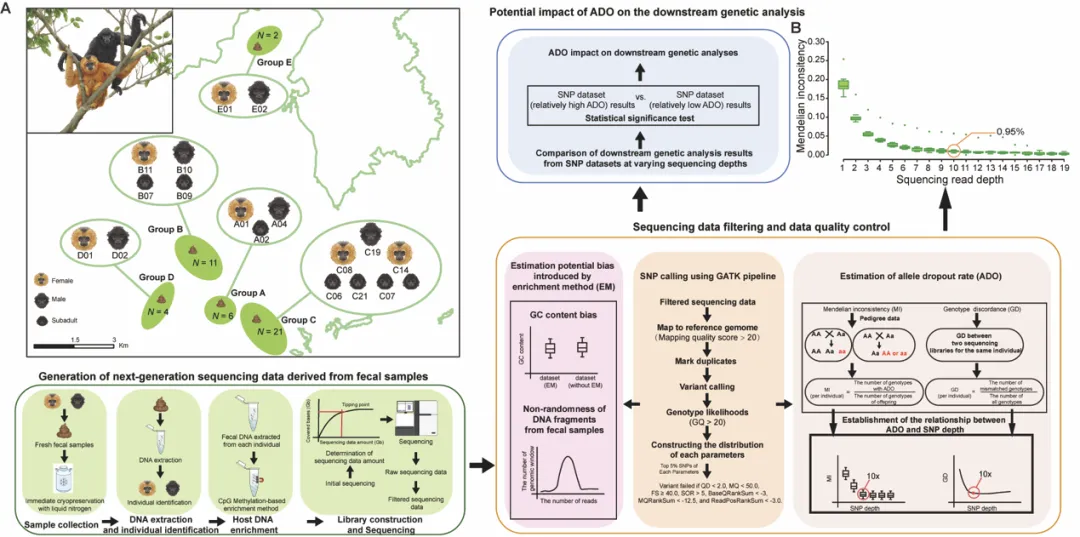
To overcome this challenge, the team developed a standardized workflow for fecal sample collection, DNA enrichment, and quality control—validating that fecal genomic data could reliably support population genetic analysis. Examining genomic data from 18 individuals (representing nearly 40 percent of the current population), the researchers discovered that the gibbon's recovery stems not only from conservation measures but also from its evolutionary "genetic legacy". Key findings reveal that population expansion over the past millennium helped buffer the species against genetic bottlenecks during the Last Glacial Maximum, with high-recombination regions aiding in reducing genetic load. Significantly, the current population comprises two ancient lineages that have undergone natural hybridization. Modeling suggests that continued hybridization could further enhance population growth potential and reduce extinction risk.The study underscores the importance of integrating population history with genomic architecture to understand species recovery mechanisms. The validated low-error fecal genome pipeline also establishes a technical paradigm for non-invasive genetic research in endangered species.
The paper's co-first authors include Dr. Hou Xian, a 2018 PhD graduate of BFU's College of Ecology and Nature Conservation, along with Professor Pan Shengkai and Professor Xu Jiliang of the same college. Co-corresponding authors are Professor Zhan Xiangjiang from the Institute of Zoology, Chinese Academy of Sciences, and Professor Zhou Jiang from Guizhou Normal University.
Paper link: https://www.science.org/doi/10.1126/sciadv.adw3298
Written by Xu Jiliang
Translated and edited by Song He
Reviewed by Yu Yangyang