

Latest news
Dr. Wang Xiaomin, a young faculty member in the College of Science at Beijing Forestry University, has published a first-author paper in PNAS, the prestigious interdisciplinary journal. Titled "The dynamics of cooperation in asymmetric public goods games", the study offers new insights into how multidimensional heterogeneity shapes collective action across different public goods structures.
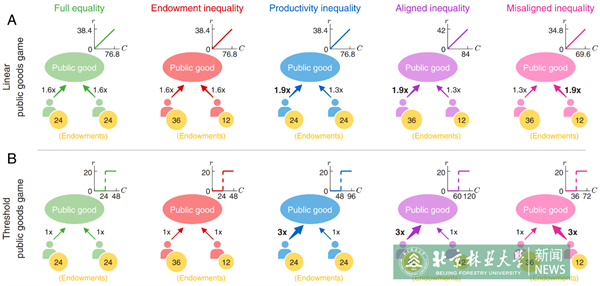
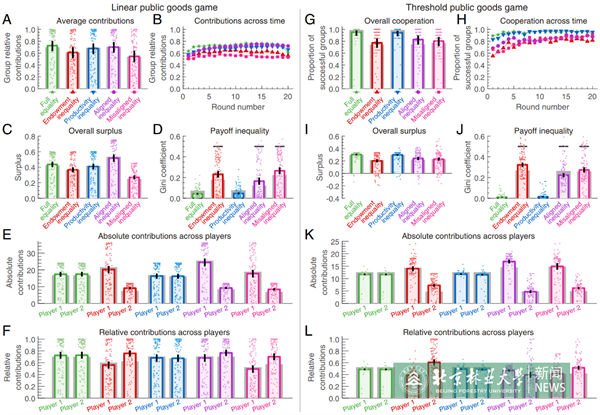
When people collaborate in groups, they routinely face collective action problems: for the group effort to succeed, individuals need to cooperate despite any incentives to defect. These problems can be modeled with public goods games. To facilitate such an analysis, many studies assume the game is symmetric. Group members have the same means to cooperate (equal endowments), and contributions of different group members are equally effective (equal productivities). Studies that allow for some inequality tend to focus on one kind of inequality only. In practice, however, people can be unequal in many ways. The effect of these inequalities may in turn depend on the specific public goods game considered. To explore these issues, we combine a large-sample experiment with extensive theoretical work. We systematically vary four aspects: the group members' endowments, their productivities, group size, and whether the public goods game exhibits linear returns or returns given by a threshold function. By exploring all four aspects, we obtain a unique dataset to explore the effect of asymmetry on cooperation. Based on this dataset, we study whether there is an advantage of "aligned inequality": whether groups achieve a better surplus if more productive individuals have a larger endowment. For public goods games with linear returns, we find such an advantage, thereby corroborating previous research. If returns follow a threshold function, however, aligned inequality results in inferior payoffs. These results show that the effect of inequality on cooperation depends on the kind of public goods game considered.
The study was conducted in collaboration with Dr. Christian Hilbe from the University of Continuing Education Krems (IT:U) / Max Planck Society, Germany, and Professor Zhang Boyu from Beijing Normal University. Dr. Wang Xiaomin from BFU's School of Science is the first author, with Beijing Forestry University as the second affiliated institution.
Paper link: https://www.pnas.org/doi/10.1073/pnas.2525760123
Written by Wang Xiaomin
Translated and edited by Song He
Reviewed by Yu Yangyang