



Latest news
A research team led by Professor Zhang Junguo from the School of Technology has made significant progress in pruning wildlife monitoring image datasets. Addressing the challenge of massive data volumes from camera traps that drive up AI training costs and reduce efficiency, the team proposed an innovative solution published as "GDP-CT: Grouped data pruning for camera trap" in Expert Systems With Applications (CAS Q1 TOP, IF: 7.5).
Camera traps provide ecologists with invaluable, large-scale visual data on wildlife in remote areas while minimizing human disturbance. However, the massive volume and inherent redundancy of images they generate impose a heavy burden on manual analysis. This has led to an increasing reliance on artificial intelligence tools for automated processing. Unfortunately, training such models remains costly and inefficient. Moreover, as datasets grow larger, the marginal gains in model performance diminish rapidly, rendering full-dataset training impractical. While dataset pruning offers a promising solution to reduce computational overhead, existing methods often perform poorly on camera trap data due to extreme class imbalance and inherent spatial domain shifts. To address these limitations, we propose GDP-CT (Grouped Data Pruning for Camera Trap), a hierarchical pruning strategy that reconciles ecological and AI-driven perspectives on image value. GDP-CT operates in three stages: (1) establishing species-level pruning quotas to ensure adequate representation of all classes; (2) within each species, allocating location-specific quotas to balance spatial diversity; and (3) within each species-location group, selecting the most representative images using standard pruning techniques. Extensive experiments demonstrate that GDP-CT significantly improves classification performance compared to standard pruning approaches. Critically, the selected subsets are model-agnostic, exhibiting strong performance across diverse architectures. Furthermore, GDP-CT seamlessly integrates with various pruning strategies, consistently improving robustness and generalization across datasets and settings. By substantially alleviating data burdens while preserving ecological insights through its principled hierarchy, GDP-CT facilitates more efficient wildlife monitoring via collaborative human-AI workflows.
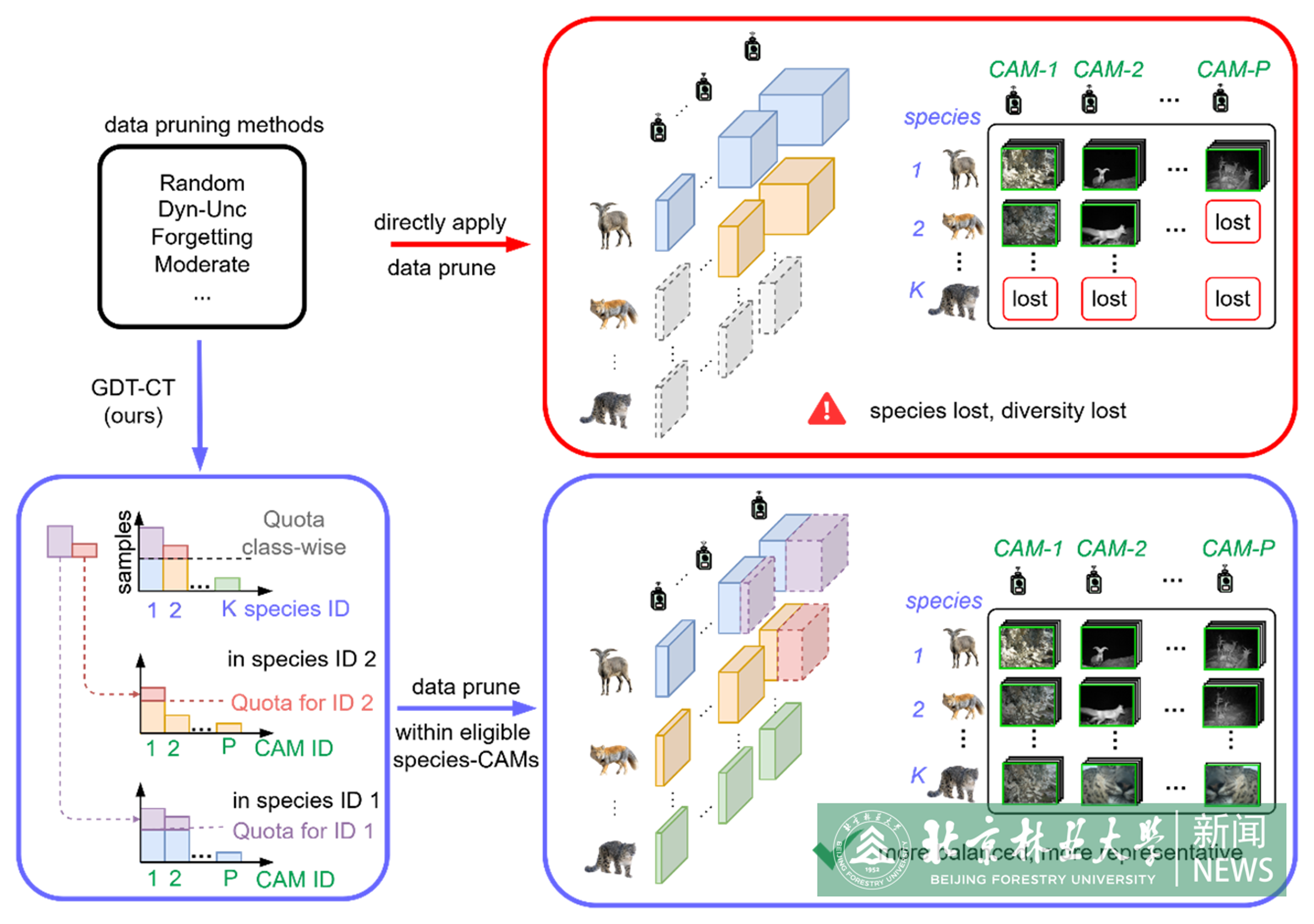
The first author is doctoral student Sha Lianshuai, with Professor Zhang Junguo serving as the corresponding author and Associate Professor Tian Ye as a contributing researcher. The study was supported by the National Natural Science Foundation of China (Grant No. 32371874).
Paper link: https://doi.org/10.1016/j.eswa.2025.130234
Translated and edited by Song He
Reviewed by Yu Yangyang


