

Latest news
A research team led by Professor Kang Xiangyang from Beijing Forestry University's College of Biological Sciences and Biotechnology has made a significant breakthrough in understanding how plants repair DNA base damage. Their study, published in the top-tier journal Plant Biotechnology Journal, reveals a novel mechanism involving a scaffold protein that coordinates key components of the base excision repair pathway in poplar.
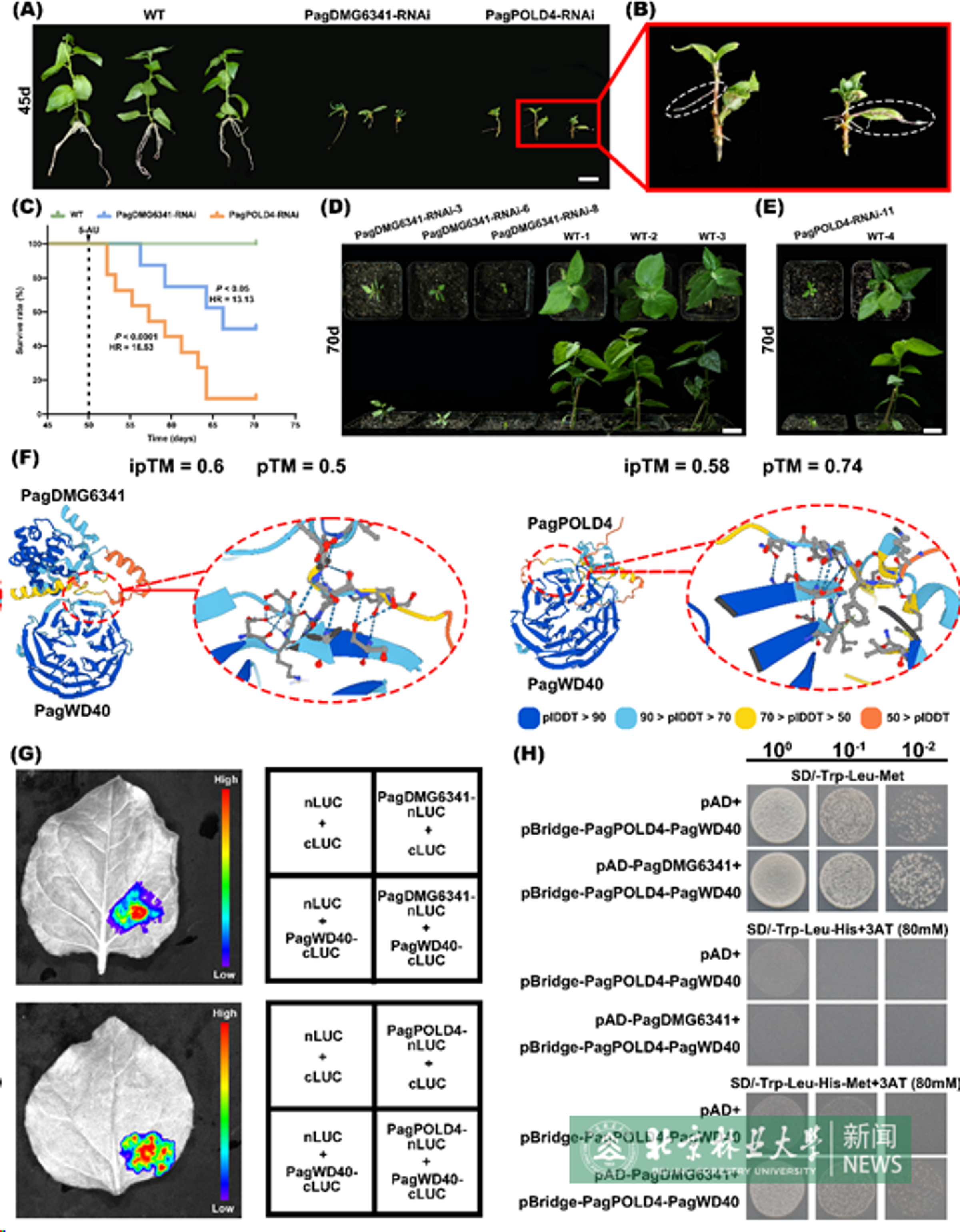
Base excision repair (BER) is a critical pathway for repairing damaged DNA bases in cells; however, the mechanisms of protein recruitment and interaction in this pathway remain largely unexplored in higher plants. In this study, we used '84K' poplar (Populus alba × P. glandulosa) as the experimental system and applied a low concentration of 5-aminouracil (5-AU) to induce DNA base lesions. Through transcriptome analysis and weighted gene co-expression network analysis (WGCNA), we identified two key BER-responsive genes: the DNA glycosylase family gene PagDMG6341 and the DNA polymerase δ subunit PagPOLD4. PagDMG6341 was significantly upregulated during the arrest phase of 5-AU treatment, whereas PagPOLD4 expression peaked during the subsequent release phase. RNA interference (RNAi) lines for each gene resulted in impaired growth and increased susceptibility to 5-AU in ‘84K’ poplar, supporting their functional roles in DNA repair and development. To further investigate their potential interaction network, we performed yeast two-hybrid (Y2H) screening, AlphaFold3-based structural modelling, confirmatory Y2H, bimolecular fluorescence complementation (BiFC) assays, and luciferase complementation imaging (LCI) assays. These experiments demonstrated that a Transducin/WD40-repeat-like scaffold protein (PagWD40) interacts independently with both PagDMG6341 and PagPOLD4. The yeast three-hybrid (Y3H) assay further showed that PagWD40 functions as a molecular scaffold, linking PagDMG6341 and PagPOLD4 to form a functional complex. This study reveals a new mechanism in which PagWD40 functions as a scaffold protein linking a DNA glycosylase with DNA polymerase δ in the plant BER pathway, thereby providing new insights into the organisation of plant DNA damage repair networks.
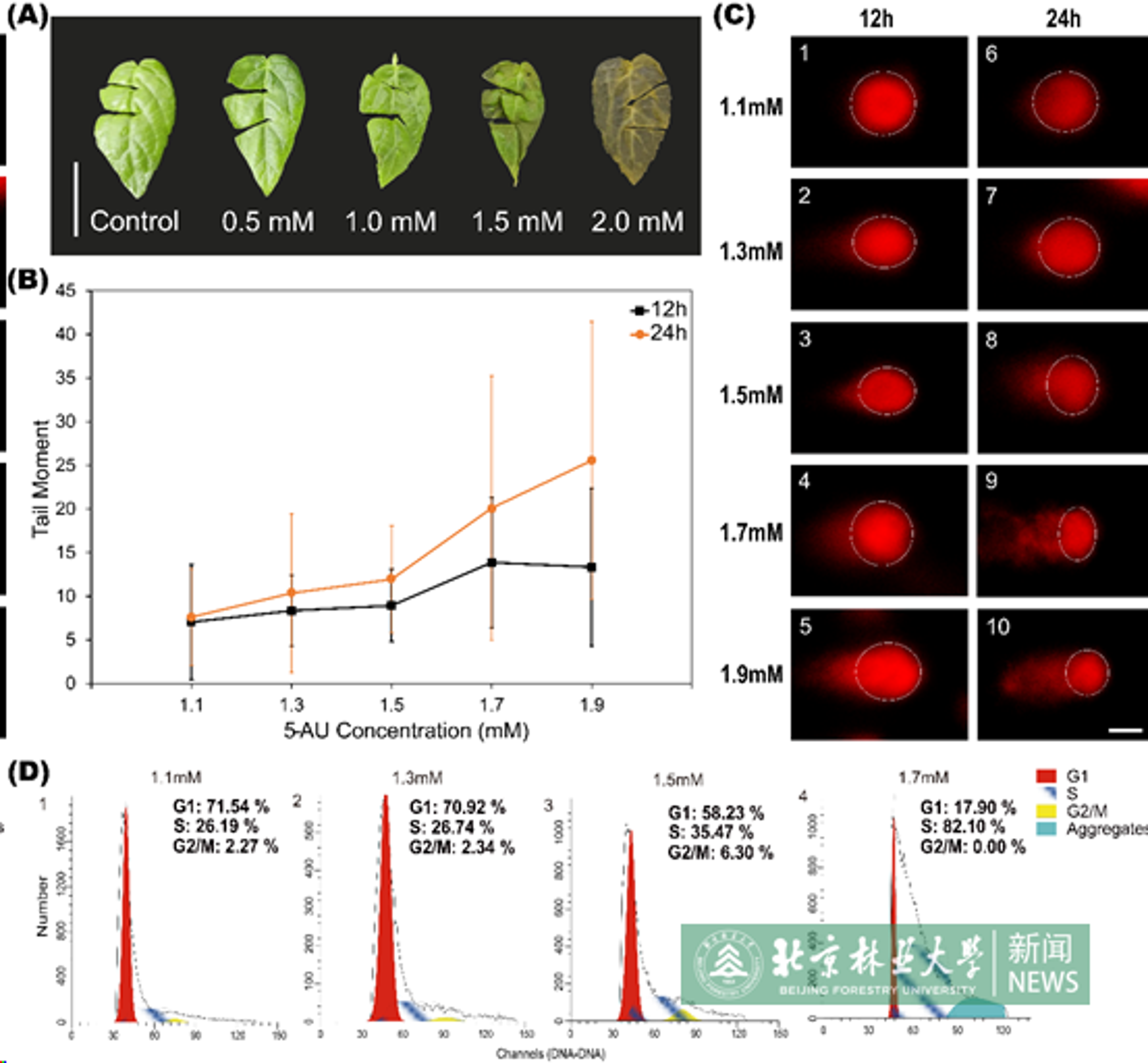
The research builds on the team's previous work using 5-AU to synchronize cell cycles for enhancing tetraploid induction in poplar. By precisely identifying the optimal timing for treatment and applying 5-AU synchronization, they achieved a tetraploid induction rate of 40.9%, nearly three times higher than conventional methods.
Ling Aoyu, a doctoral student, led the study as first author, alongside co-corresponding authors Professors Kang Xiangyang and Zhang Pingdong.
This work was supported by the National Key R&D Program of China during the 14th Five-year Plan Period (2021YFD2200104) and the Postdoctoral Fellowship Program of CPSF under Grant Number GZC20251298.
Paper link: https://doi.org/10.1111/pbi.70543
Written by Kang Xiangyang
Translated and edited by Song He
Reviewed by Yu Yangyang