
Latest news
Plastic serves as a cornerstone of modern society, playing an indispensable role in both daily life and industrial production. However, only 9% of plastic waste is recycled, while as much as 91% ends up in landfills or is incinerated. Plastic pollution has become a serious global challenge. In particular, petroleum-based plastics undergo weathering and degradation in the natural environment, gradually forming micro- and nano-plastics, which exhibit remarkable environmental persistence. Furthermore, plastic products contain tens of thousands of chemical additives, which can continuously migrate into the environment and biota throughout their life cycle, thereby posing additional health risks. Despite the implementation of plastic bans and the promotion of recycling programs in numerous countries, the effectiveness of these measures remains limited due to low recycling rates and persistent reliance on fossil-based plastics. Therefore, developing high-performance biomass-based biodegradable plastics is broadly accepted as the effective way of alleviating the aforementioned issues.
A research team led by Professor Peng Feng and Lecturer Rao Jun from the College of Materials Science has developed a novel strategy to transform xylan, a byproduct of the pulp and viscose fiber industry, into high‑performance bioplastics. The work, published in Research, offers a promising route to convert industrial waste into sustainable materials.
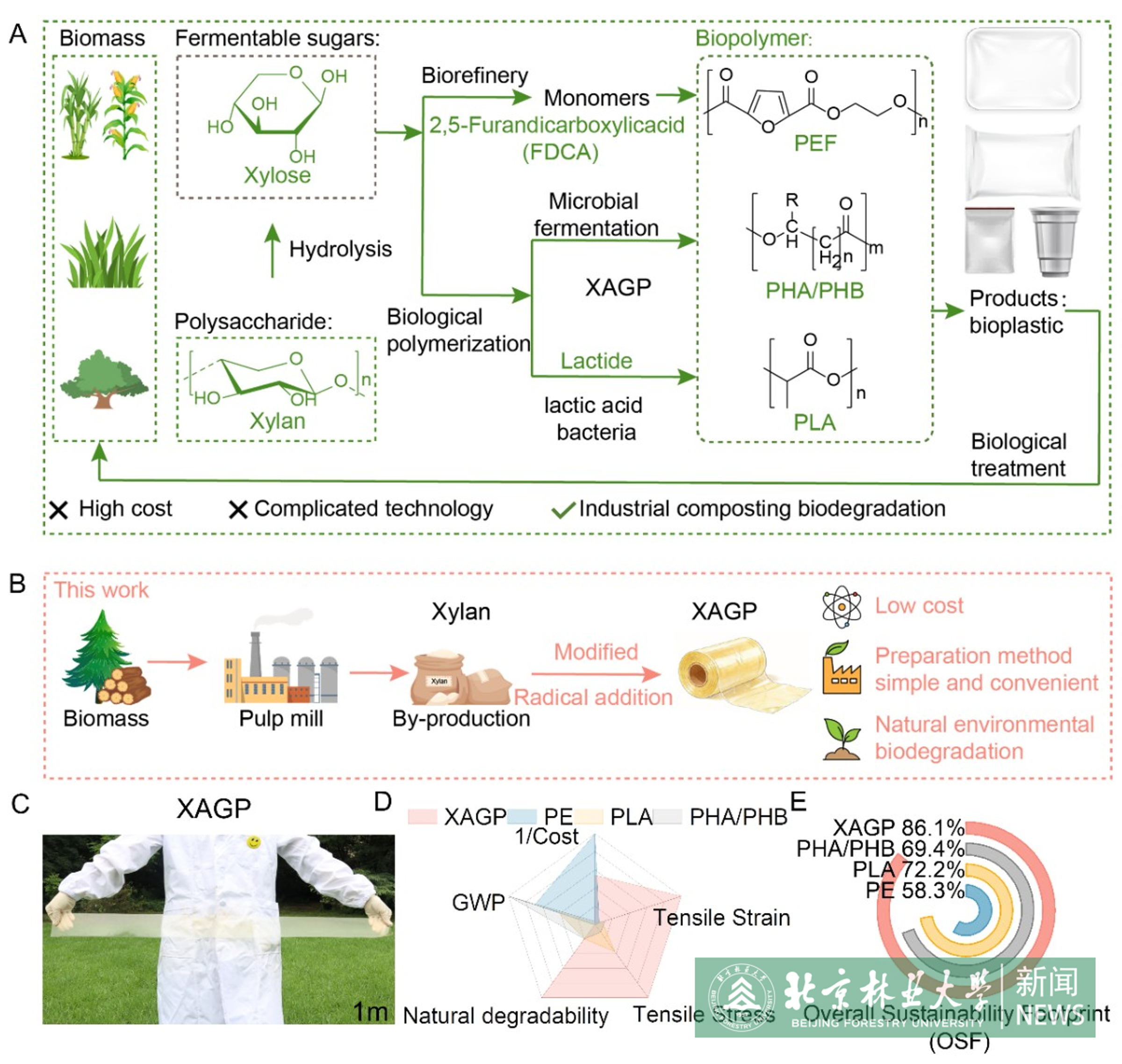
Bioplastics derived from hemicellulose exhibit marked potential to substitute petroleum-based plastics due to their sustainability and biodegradability. However, developing bioplastics that combine facile manufacturing processes, excellent mechanical properties, and a low carbon footprint remains challenging. Herein, the research team present a strategy for fabricating high-performance bioplastics (XAGP) by crosslinking xylan molecular chains via photo-induced free-radical polymerization. The XAGP exhibits high light transmittance (95%), exceptional mechanical toughness (26 MJ/m3) and mechanical strength (84 MPa), outstanding thermal stability, water-assisted processability, rapid biodegradability (10 days in nature soil), hypotoxicity in aquatic environments, and good biocompatibility (cell viability above 98%). Furthermore, cost and life cycle assessment results demonstrate that XAGP is a more sustainable alternative to commercial biodegradable plastics, offering greater cost-effectiveness and a reduced carbon dioxide emission. This work establishes a promising route for transforming pulp waste into degradable, high-performance bioplastics, providing an effective solution to both waste disposal and plastic pollution.
The paper's first author is doctoral student Jia Siyu, with Professor Peng Feng and Lecturer Rao Jun as co‑corresponding authors.
The research received funding from the National Science Fund for Distinguished Young Scholars (32225034), the National Natural Science Foundation of China (22278036), the National Natural Science Foundation of China (32401516), the China Postdoctoral Science Foundation (2025T180546), and the Fundamental Research Funds for the Central Universities (QNTD202507).
Paper link: https://spj.science.org/doi/10.34133/research.1344
Written by Rao Jun
Translated and edited by Song He
Reviewed by Yu Yangyang