



Latest news
A BFU research team led by Professor Peng Feng has published a "Hot Paper" in Angewandte Chemie International Edition on Fibroblast-Mimetic Lignin Polymersomes for Logic-Gated Synthesis of Mechanically Reconfigurable Bioskins. Inspired by fibroblasts, the team proposed a strategy for co-assembling lignin with divinyl ligands to create biomimetic polymersomes, enabling logic-gated programming of mechanically reconfigurable bioskin materials.
Ageing is inevitable and accompanied by progressive loss of skin elasticity. Fibroblasts, embedded within the extracellular matrix, finely regulate skin mechanics via membrane-bound ligands. Creating synthetic assemblies that mimic fibroblast function is appealing yet challenging. Here, we present a strategy that co-assembles lignin with divinyl ligands to generate fibroblast-mimicking polymersomes, enabling precise programming of bulk materials to emulate human skin across distinct physiological stages. Because lignin polymersomes are driven by relatively weak π–π stacking, hydrophobic ligands efficiently intercalate among aromatic rings, and their interfacial distribution can be tuned via molecular engineering. The polymersomes can be programmed in a Boolean logic‑gate manner (OR, AND, and NOT) to synthesize skin-mimetic gels with tailored mechanical properties, analogous to fibroblast behavior. Furthermore, the platform enables on‑demand, high‑resolution 3D printing of complex bioskin architectures. This work provides a biomimetic paradigm for the synthesis and precise control over assembly from the molecular to the macroscopic scale.
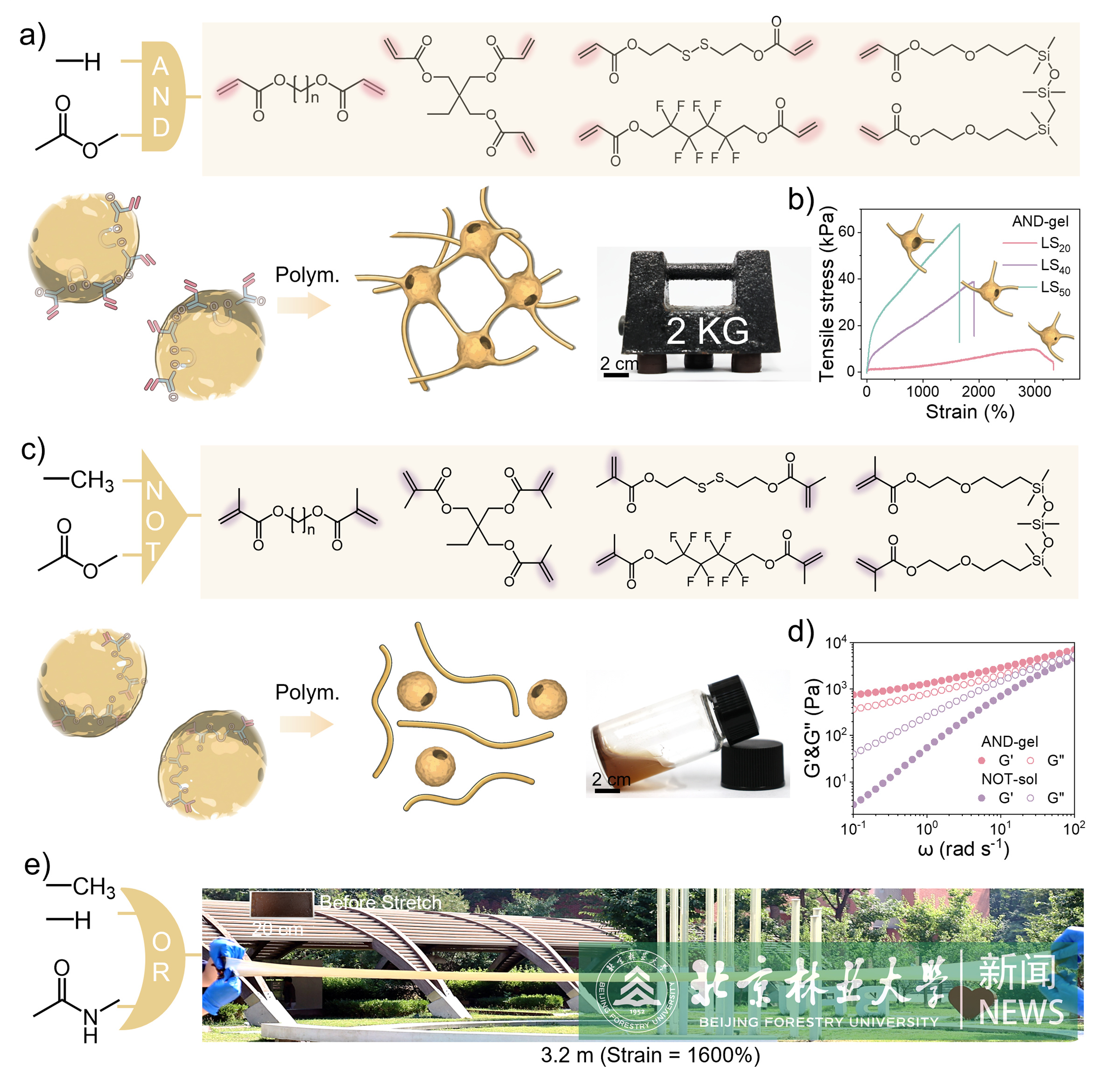
The co-first authors are Dr. Wang Hairong (now at Xinjiang University) and Ph.D. student Liu Xujing, both from the College of Materials Science and Technology. Associate Professor Hao Xiang and Professor Peng Feng are co-corresponding authors. The research was supported by the National Natural Science Foundation of China(22478035), the National Science Fund for Distinguished Young Scholars(3225034), and other funding sources.
Paper link: https://doi.org/10.1002/anie.6127627
Written by Hao Xiang, Peng Feng
Translated and edited by Song He
Reviewed by Yu Yangyang


