

Latest news
What can students learn beyond textbooks and lectures? For students at Beijing Forestry University (BFU), the answer lies in a series of vibrant hands-on labor education programs, which turn the campus into a living classroom for life skills, work ethic and character building. With more than 20 tailored initiatives covering everything from culinary arts to emergency first aid, the programs have become a beloved part of campus life, reaching over 9,000 students and redefining the meaning of learning for the younger generation.
The full text of the report is as follows:
On April 1, just days before Qingming Festival, or Tomb-Sweeping Day, a lively cooking workshop took place in the cafeteria at Beijing Forestry University (BFU). At the counter, 19-year-old Li Tonghan carefully shaped a green rice ball — qingtuan, a traditional seasonal delicacy enjoyed during the festival.
"The workshop is very popular — around 80 percent of our classmates signed up," Li said. "The instructors are cafeteria staff who guide us step by step. Even those with no cooking experience can easily keep up."
For Li, a freshman studying mathematics with a demanding academic schedule, the two-hour cooking session offered a welcome break.
"Doing something with my hands really helps me relax," he said. "It also makes me appreciate the cafeteria staff's work even more."
This cooking class is part of BFU's broader initiative to promote hands-on learning and a strong work ethic, explained Chen Yuzhen, deputy Party secretary of the university's logistics support department. According to her, more than 20 similar programs have been introduced, covering campus services, daily life skills, and practical training for future careers.
So far, over 9,000 students have participated, with most sessions limited to 20 participants to ensure a more interactive experience.
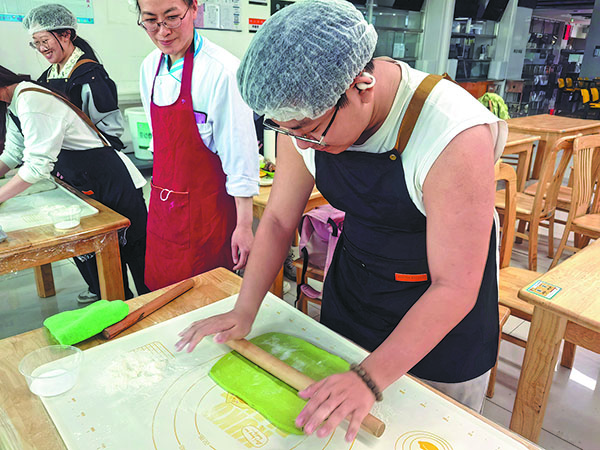
Li Tonghan (front) learns to make huajuan (steamed twisted rolls) during a course held in the cafeteria at Beijing Forestry University.
"We hope these courses allow students to experience real-world campus work and develop greater respect for labor," Chen said. "At the same time, they acquire practical skills that will benefit them after graduation."
For many participants, these activities also help build confidence in handling unexpected situations.
Song Linshuo, 19, enrolled in a basic first aid and health training course at the campus clinic, where students learned cardiopulmonary resuscitation (CPR), how to use automated external defibrillators (AEDs), the Heimlich maneuver for treating choking, and how to respond to snake or insect bites — skills especially useful for forestry majors like Song.
"After completing the session, I feel much more confident and capable. In an emergency, I'll be ready to take action and provide help immediately," he said.
According to Song, the university encourages students to participate in hands-on experiences from their very first year, a practice he finds particularly valuable. "Labor is everywhere. It's not just farm work — it includes cleaning, cooking, and everything we do in our daily lives," he said.
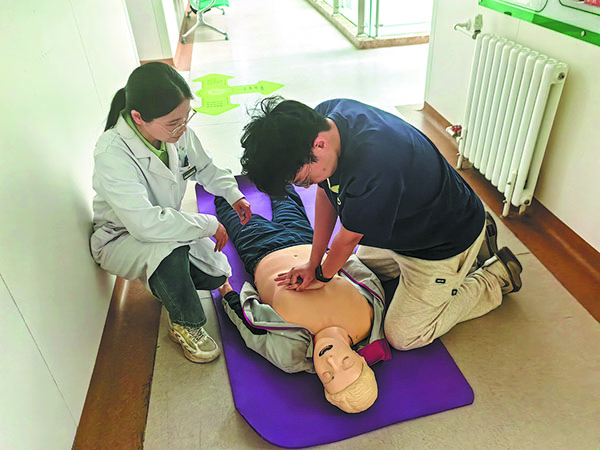
Song Linshuo (right) learns how to perform cardiopulmonary resuscitation (CPR) in a training session at BFU.
For example, his major involves regular fieldwork, such as carrying heavy tripods, taking measurements in the mountains, and drawing maps.
"No matter how advanced technology gets, there are always aspects of life we must still manage ourselves," he said. "Creating things with our own hands brings a real sense of satisfaction."
(From China Daily)