

Latest news
A research team from BFU's School of Landscape Architecture has published a landmark study in Nature Plants (IF=15.0), successfully decoding the complex genome of hexaploid cultivated chrysanthemum and elucidating its origin and domestication history. The study was highlighted in a companion research briefing in the same issue.
The modern cultivated chrysanthemum (Chrysanthemum × morifolium Ramat.) is a globally important ornamental crop, ranking as the second largest cut flower by market share after roses1,2. However, the hexaploid genome and hexasomic inheritance characteristics of chrysanthemum present substantial challenges to haplotype-resolved genome assembly3. Long-term domestication and artificial selection have produced diverse flower colours, flower types and plant architectures in modern cultivated chrysanthemums. However, the origin and domestication history of cultivated chrysanthemums, as well as the genomic basis of key agronomic traits, remain unclear. Integrating multidisciplinary evidence from germplasm resources, morphological taxonomy, artificial hybridization, cytology and molecular systematics, it is widely accepted that cultivated chrysanthemums constitute a cultivated hybrid complex developed through interspecific germplasm introgression and long-term artificial selection. However, this hypothesis lacks systematic evidence at the whole-genome level. The origin and domestication of cultivated chrysanthemums remain controversial, and crucial questions regarding the wild progenitor Chrysanthemum species and their genetic contributions have yet to be fully clarified.
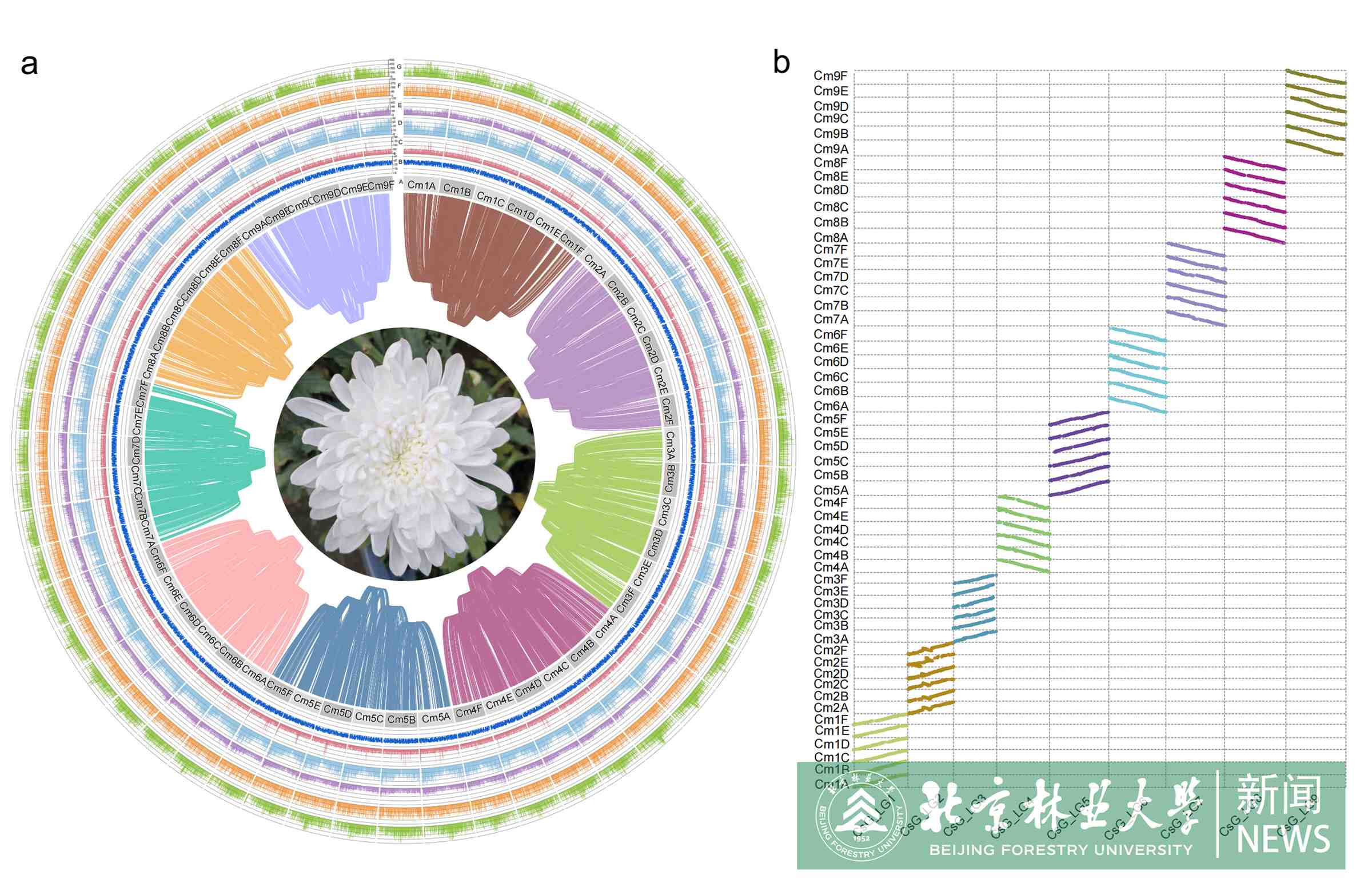
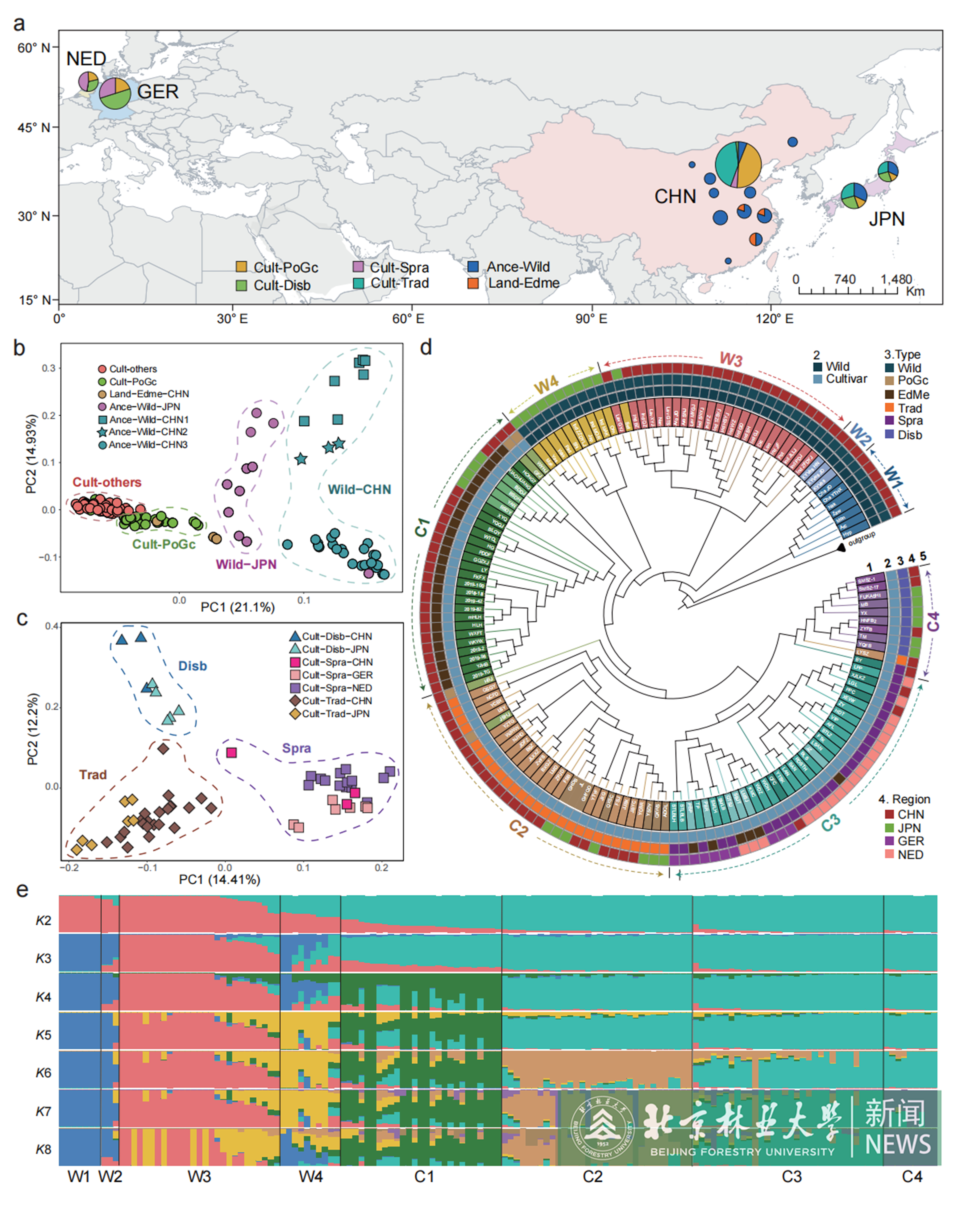
The team successfully resolved six haplotypes of the elite hexaploid cut Chrysanthemum cultivar 'Jinba' (2n = 6x = 54). The assembled genome was 17.60 Gb. BUSCO analysis yielded a completeness score of 99.14%, and KAT assessment showed 96.34% k-mer completeness, indicating reliable haplotype phasing. The six haplotypes exhibited strong collinearity, and shared good synteny with the diploid Chrysanthemum seticuspe and hexaploid C. × morifolium 'Zhongshanzigui' genomes. A comprehensive genome-wide variant map of the Chrysanthemum genus was constructed, based on 147 core wild and cultivated accessions. Existing Chrysanthemum varieties were classified into eight groups via population structure analysis, including four wild and four cultivated groups, with wild accessions collected from Japan and China — suggested geographic origins of C. × morifolium — clustering separately. They detected extensive and complex gene flow: from wild to cultivated groups, among cultivated groups and within wild groups. Notably, the reaserch team verified that wild germplasm resources from both China and Japan contributed substantially to the rich diversity of modern cultivated Chrysanthemum varieties. Furthermore, a map was generated to illustrate the hypothesized global dispersal routes of cultivated chrysanthemums, which revealed that the middle-lower reaches of the Yellow and Yangtze Rivers, together with the eastern Qinling Mountains of China, serve as one of the primary origin centres. After being introduced to Japan, cultivated chrysanthemums incorporated local wild germplasm and formed a new diversity centre. Following their introduction to Europe, intensive breeding yielded a novel spray chrysanthemum cultivar. Ongoing global dissemination and improvement have shaped the rich phenotypic diversity of modern cultivated chrysanthemums. The extant relatives of each progenitor wild species were also identified, confirming that Chrysanthemum indicum was one of the key ancestors of modern chrysanthemum cultivars. Finally, the team identified candidate loci and genes associated with core agronomic traits, including plant architecture, flower type and flower colour.
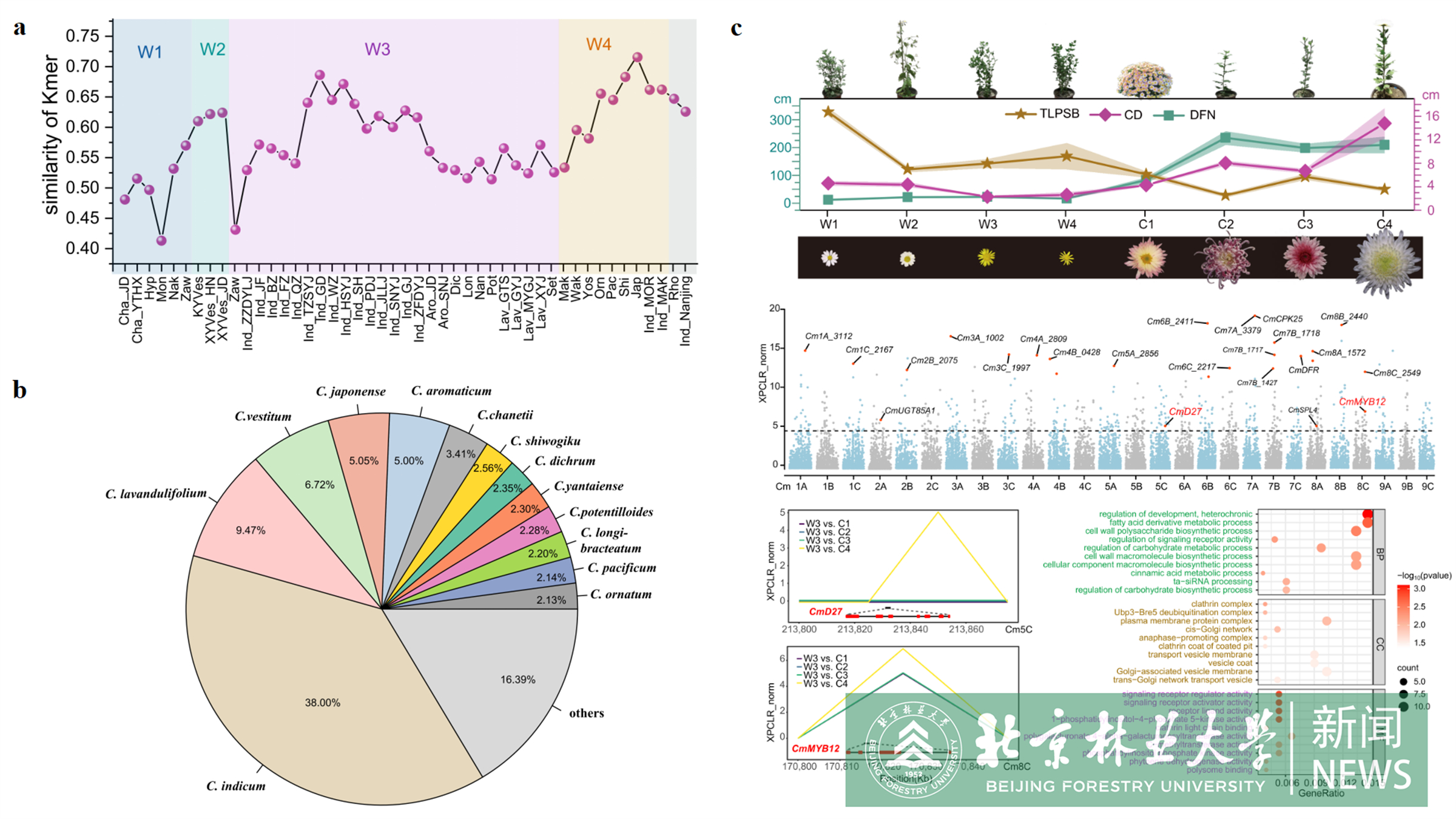

The work builds on pioneering research initiated in the 1960s by Academician Chen Junyu, a horticulture pioneer at BFU, who first proposed that cultivated chrysanthemum is a hybrid complex, and this study marks a new advance in that long‑standing scientific pursuit.
"This study is original, leveraging a unique genomic resource in a highly complex polyploid ornamental species. The scope and quality of the data, combined with integrative analytical approaches, make this work highly relevant to researchers in Chrysanthemum biology and domestication. The functional insights provided by genome-wide association studies will also interest the broader Asteraceae and evo-devo communities." Nicolas B. Langlade, Université de Toulouse, INRAE, UMR LIPME, Castanet-Tolosan, France.
The research was conducted by BFU in collaboration with BGI. Co‑first authors include Associate Professor Yuan Cunquan and doctoral students Cong Tianci and Sun Tingting from BFU, alongside Dr. Zhang Rui, Dr. Liu Yalin, and Dr. Li Chunhua from BGI. Co‑corresponding authors are Professor Cheng Tangren, Professor Zheng Tangchun, and Professor Zhang Qixiang from BFU, along with Professor Zhang He and Professor Fan Guangyi from BGI.
This work was supported by the National Key Research and Development Project of China (grant no. 2023YFD1200105), the Fundamental Research Funds for the Central Universities (grant nos QNTD202503, QNTD202306 and 2021BLRD08), the National Natural Science Foundation of China (grant no. 32071827), the Science and Technology Innovation Project of the Xiongan New Area (grant no. 2022XAGG0100) and the Special Fund for Beijing Common Construction Project.
Paper link: https://www.nature.com/articles/s41477-026-02366-w
Research briefing link: https://www.nature.com/articles/s41477-026-02365-x
Written by Yuan Cunquan
Translated and edited by Song He
Reviewed by Yu Yangyang